





Human Rights
Supporting the SDGs Goals
Commitment
- We are committed to conducting business responsibly and respecting the human rights of all relevant stakeholders, in alignment with international standards — including the Universal Declaration of Human Rights (UDHR), the United Nations Global Compact (UNGC), the UN Guiding Principles on Business and Human Rights (UNGP), and the Children's Rights and Business Principles.
- The Company places great importance on integrating these principles into its corporate governance processes, organizational policies, and business practices — with the aim of preventing and mitigating the risk of human rights violations, while fostering a corporate culture that upholds human dignity, equality, and fairness in every dimension.
- Tanachira Group firmly believes that a commitment to human rights is a fundamental foundation for sustainable growth, and an integral part of creating long-term value for all stakeholders.


Goals and Performance Highlights
Goals
- Zero complaints related to human rights violations.
Performance in 2025

Human rights training delivered to sales staff to ensure appropriate customer service and reduce human rights-related risks.

A comprehensive company-wide human rights due-diligence conducted.
Challenges and Opportunities
Tanachira Retail Corporation Public Company Limited conducts its business with a strong commitment to respecting and protecting the fundamental human rights and labor rights of all stakeholders across its value chain — including employees, contractors, suppliers, business partners, and the communities in which it operates — guided by its corporate code of conduct, applicable laws, and sound corporate governance principles.
The Company recognizes that human rights violations — such as discrimination, harassment, child labor, or forced labor — can give rise to legal risks, financial penalties, litigation, and long-term damage to brand reputation and stakeholder trust. Accordingly, the Company has established clear policies and practices to systematically prevent and manage such risks.
Management Approach and Value Creation

Promoting a Fair and Safe Working Environment

The Company is committed to creating a working environment that is safe, respectful of human dignity, and free from discrimination in all forms — actively promoting Diversity, Equity, and Inclusion (DEI) throughout the organization. The Company places particular emphasis on:

Fair and appropriate compensation

Gender equality and equal opportunities for career advancement

Prevention of abuse, intimidation, and harassment in the workplace

Occupational health and safety standards
These commitments strengthen employee engagement, reduce turnover, and support the sustainable development of human capital — forming a critical foundation for long-term organizational growth.

Elevating Standards Across the Supply Chain

As an operator and manager of global lifestyle brands, the Company recognizes its responsibility to encourage suppliers and business partners to uphold human rights principles and fair labor practices.

The Company establishes clear ethical and social responsibility criteria and expectations for its partners, and promotes the assessment and monitoring of human rights risks throughout the supply chain — ensuring that business operations at every stage remain transparent, accountable, and aligned with international standards.

Managing Human Rights Impacts

The Company conducts assessments of both actual and potential human rights risks and impacts across all stakeholder groups, and puts in place appropriate preventive, corrective, and remedial measures. In addition, the Company has established grievance mechanisms that are fair, transparent, and accessible — providing employees and stakeholders with a safe channel to raise concerns without fear of retaliation.

Linking Human Rights to Environmental and Community Dimensions

The Company recognizes that human rights extend to the rights of communities and the environment. It therefore prioritizes efficient resource use, waste reduction, the promotion of environmentally responsible practices, and conducting business with due regard for the health and quality of life of surrounding communities.
This approach not only mitigates legal risks and social conflicts, but also builds trust among customers, investors, and business partners who value responsible and sustainable growth.

Human Rights Due Diligence

Defining the Scope
The Company defines the scope of its human rights due diligence process to encompass both internal operations and its entire value chain, covering all stakeholder groups as well as vulnerable populations including women, children, minorities, indigenous peoples, migrant workers, third-party contracted workers, persons with disabilities, LGBTQ+ individuals, the elderly, and pregnant women. The assessment addresses all relevant human rights issues, including labor rights, community and environmental rights, supplier rights, and customer rights — ensuring comprehensive coverage of human rights matters across all business processes.
Identifying Human Rights Issues
The Company conducts a comprehensive identification of human rights risks related to its business processes — covering both actual and potential risks arising from its own operations, as well as those occurring through the activities of suppliers, contractors, or joint venture partners that could result in complicity in human rights violations. The Company also reviews human rights trends within the same industry sector, then categorizes the identified risk issues into a human rights risk checklist relevant to its business, before assigning relevant departments to jointly assess potential human rights risks.
Defining the Scope of Human Rights Issues

Labor Rights
Occupational health, working environment and workplace safety; fair treatment of workers; protection of employees' personal data.

Community and Environmental Rights
Occupational health, environment, and safety.

Customer Rights
Privacy violations; discrimination against customers; quality, health, and safety of products and services

Supplier Rights
Occupational health, environment, and safety; unfair treatment of suppliers; illegal use of labor
Human Rights Due Diligence
The Company conducts human rights risk assessments by evaluating potential impacts on stakeholders across the entire value chain. This includes employees, customers, suppliers, contractors, supply chain workers, local communities, society, and vulnerable groups who may be affected by the Company's business operations.
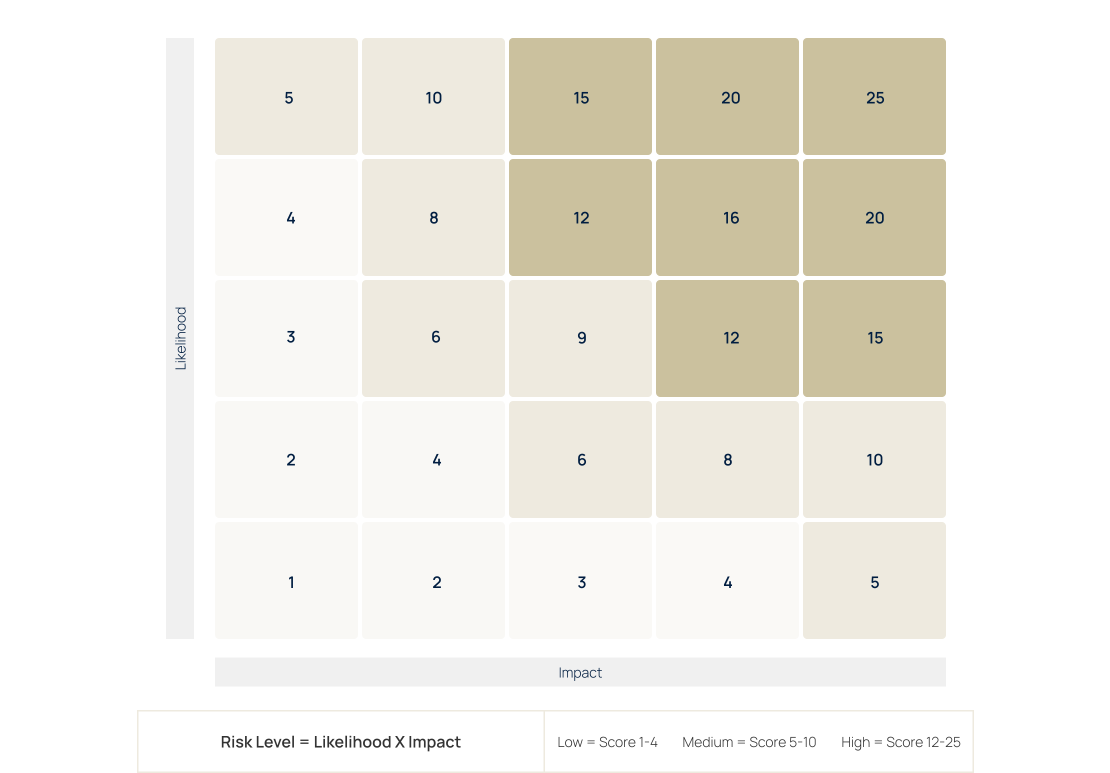
The risk assessment framework is based on two primary components: the severity of the human rights impact and the likelihood of its occurrence. The severity of the impact is determined by its scale, scope (the number of affected individuals), and the remediability of the consequences. Notably, the Company prioritizes issues with critical severity or those that are difficult to remediate, even if the likelihood of occurrence is deemed low
Severity
| Point | Level | Scale of Impact | Scope of Impact | Remediability |
|---|---|---|---|---|
| 5 | Very High | Severe adverse impacts on life, safety, liberty, dignity, privacy, or fundamental rights of the affected individuals; such as fatalities, severe injuries, child labor, forced labor, large-scale breaches of sensitive personal data, or severe discrimination. | Widespread impact at the corporate level, affecting multiple brands, branches, or locations, or impacting nearly all stakeholders within that specific group. | Irremediable or causing permanent, long-term impacts; such as fatalities, permanent disabilities, severe violations of human dignity, large-scale leaks of sensitive personal data, or egregious labor rights violations. |
| 4 | High | Significant adverse impacts on health, safety, well-being, income, privacy, or fair service delivery; requiring serious remediation and potentially leading to official complaints or investigations by external regulatory bodies. | Significant impact affecting a large number of stakeholders, multiple business units, branches, or areas, or significantly impacting vulnerable groups. | Difficult to remediate, time-consuming, and requiring collaboration across multiple agencies, with potential residual impacts on victims, such as damage to reputation, trust, health, or privacy. |
| 3 | Medium | Perceptible impacts on the rights or well-being of stakeholders, yet not severe; fully remediable through internal processes such as remediation, service improvements, data rectification, or environmental enhancements. | Impacts a limited number of stakeholders within specific business units, branches, locations, or certain customer/supplier groups. | Remediable within a moderate timeframe, requiring a systematic action plan for correction, compensation, communication, or process improvement. |
| 2 | Low | Limited impact involving an isolated incident or localized case, causing only minor rights infringements or inconvenience, and manageable by relevant departments within a short timeframe. | Impacts only an individual or a small group within a restricted area; such as a single branch, a single incident, or a single supplier. | Remediable within a rapid timeframe through localized corrective action, clarification, apology, compensation, or procedural improvement. |
| 1 | Very Low | Negligible impact with no significant consequences on the health, safety, dignity, privacy, or rights of stakeholders, and can be resolved immediately. | Impacts a very small number of individuals and does not expand to other groups. | Remediable immediately or almost immediately, leaving no residual impact on the affected individuals. |
Likelihood
| Point | Level | Likelihood of Occurrence |
|---|---|---|
| 5 | Very High | Highly probable or highly likely to occur due to the nature of routine, high-frequency activities involving a large number of stakeholders, or activities that inherently carry a high risk of human rights impacts (e.g., occurring annually or having widespread exposure) |
| 4 | High | Probable or likely to occur, as the activities are frequent and involve multiple business units, branches, locations, a large number of suppliers or external parties, or incidents have recurred periodically in the past (e.g., every 1–3 years) |
| 3 | Medium | Occasional or possible to occur, involving a moderate number of stakeholders, or with related incidents, complaints, or issues arising infrequently (e.g., every 4–7 years) |
| 2 | Low | Improbable or unlikely to occur, as the activities are infrequent and involve a limited number of stakeholders, or incidents have occurred very rarely in the past (e.g., once every 8–10 years) |
| 1 | Very Low | Highly improbable or very unlikely to occur, as the activities are of extremely low frequency and involve very few stakeholders, or no such incidents have occurred in the past (or occurred more than 10 years ago) |
Risk Matrix
Note:
- For human rights risk assessments, if an issue meets the Severity Priority criteria but its Risk Matrix score does not reach the High level, it shall be classified as “High by Severity.”
- Severity Priority Criteria Impact Score = 5, Remediability = 5, Scale = 5 with Remediability of at least 4 and Scope of at least 3.
Determination of Human Rights Mitigation Measures

Upon completion of the human rights risk assessment, the Company will formulate measures to manage potential human rights impacts. These measures will focus primarily on minimizing and controlling negative impacts to ensure they are kept to the lowest possible level or prevented entirely. Furthermore, the Company establishes guidelines to directly coordinate with affected or potentially affected parties such as employees, business alliances, suppliers, contractors, customers, communities, and society. In order to actively manage impacts and remediate human rights issues.
Human Rights Performance Monitoring and Review

The Company continuously conducts human rights risk and impact assessments, ensuring that identified issues are regularly reviewed on an annual basis. This process accounts for potential shifts in risk profiles resulting from changes in business activities, processes, and stakeholder groups. Furthermore, the Company has established key performance indicators (KPIs) to monitor and evaluate its human rights performance, with performance outcomes reported annually through the Form 56-1 One Report or the official corporate website.
Remediation
The Company has remediation measures in place for those affected by human rights violations, encompassing both financial and non-financial assistance in the short and long term. These measures aim to provide relief to those whose rights have been violated, while also seeking to prevent recurrence — for example, through reviewing relevant policies or work processes, conducting employee training, communicating with relevant stakeholder groups, and monitoring remediation measures to ensure the Company conducts its business with full respect for human rights across its entire value chain, and that effective and appropriate measures are in place to prevent the risk of human rights violations.
In the event of a human rights violation, the Company will conduct a fair and impartial investigation and apply disciplinary measures in accordance with its regulations and rules, as follows:

Verbal Warning

Written Warning

Suspension

Termination
Comprehensive Human Rights Due Diligence Results
The Company has conducted a comprehensive human rights risk assessment in accordance with its established risk evaluation criteria. In 2025, the Company identified 17 human rights issues covering key stakeholders across the entire value chain, including employees, customers, suppliers, contractors, supply chain labor, communities, and society, as well as vulnerable groups who may be impacted by the Company's business operations.
Based on the assessment results, the Company evaluated the severity of human rights impacts alongside their likelihood of occurrence to identify Salient Human Rights Issues. These have been categorized into 4 core areas as follows:

01

02

03

04
The Company has analyzed these risk factors to establish appropriate preventive measures, guidelines, and remediation plans. These measures are integrated into our core business processes and relevant activities to reduce the likelihood of occurrence, minimize severity, and mitigate potential impacts on stakeholders, while supporting the continuous monitoring and management of Salient Human Rights Issues. Details are as follows:
| Risk Scenario/Event | Risk Factors | Preventive Measures/Guidelines | Remediation Action |
|---|---|---|---|
| Work-related injuries or illnesses of employees, suppliers, and communities |
|
|
|
| Unsafe or sub-standard products and services |
|
|
|
| Personal data breaches / Data leakage |
|
|
|
| Discrimination and unfair treatment of stakeholders: employees, customers, and supply chain labor |
|
|
|
Incidents of Human rights Violations
For the year 2025, the Company received no complaints related to human rights violations, and therefore no remediation or corrective measures were required.

Should any incident potentially involving a human rights violation be observed, it may be reported to the Company through the following channels.
Grievance Channel for Reporting Human Rights Violation Incidents
Stakeholders Directly Impacted